Why Intelligent Welding and Electrostatic Spraying Matter for Heavy-Duty Library Carts
For library furniture distributors and institutional procurement officers, the “library cart” (or book truck) is deceptively simple. It looks like a few shelves on wheels. However, anyone who has managed a library facility knows the harsh reality: cheap carts fail.
Wobbly wheels, snapping welds under heavy loads, and paint that peels after a few months of use—these are the nightmares of facility managers.
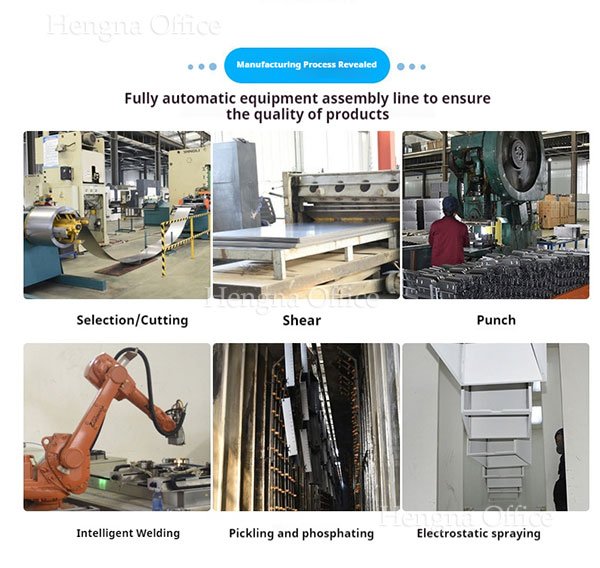
As a premier Steel Book Trolley Manufacturer offering OEM and ODM solutions, we believe that quality isn’t an accident; it is the result of precise manufacturing processes. Today, we are pulling back the curtain on our production line to explain why Intelligent Welding and Electrostatic Spraying are non-negotiable features for high-quality, heavy-duty library carts.
1. The Backbone: Intelligent Welding vs. Manual Welding
The structural integrity of a 2-tier or 3-tier book trolley depends entirely on how the steel components are joined. In the past, manual welding was the standard. While skilled craftsmen are valuable, manual welding introduces variables: human fatigue, inconsistent angles, and varying speed.
In our factory, we utilize Intelligent Robotic Welding (as seen in our production photos). Here is why this matters for your inventory:
Consistency is Key
A library cart fully loaded with encyclopedias or reference books can weigh over 100kg. If one weld point is weak (a “cold joint”), the entire structure is compromised.
- Robotic Precision: Our automated arms follow the exact same path, at the exact same speed, and at the exact same temperature for every single cart.
- Deep Penetration: Intelligent welding ensures the weld penetrates deep into the cold-rolled steel, creating a bond that is stronger than the metal itself.
The “Wobble” Factor
Nothing frustrates a librarian more than a cart that “crabs” or wobbles down the aisle.
- Manual welding can sometimes warp the steel frame due to uneven heat distribution.
- Intelligent Welding minimizes heat-affected zones, ensuring the frame remains perfectly square. This guarantees that when the casters are attached, all four wheels touch the ground evenly.
Manufacturer’s Note: For our OEM clients, this means a drastic reduction in after-sales complaints regarding structural failures.
2. The Skin: The Power of Electrostatic Spraying
Once the structure is built, it must be protected. Steel, by nature, wants to rust. This is where the finishing process becomes the difference between a cart that lasts 2 years and one that lasts 20.
We utilize a fully automated Electrostatic Spraying (Powder Coating) line. This is superior to traditional “wet paint” for several reasons:
Step 1: Pickling and Phosphating (The Hidden Step)
Before any paint touches the metal, our steel goes through a rigorous Pickling and Phosphating process.
- Pickling: Removes all impurities, oil, and rust from the raw steel.
- Phosphating: Creates a microscopic crystalline layer on the surface that acts like “velcro” for the powder coating.
- Why it matters: If a manufacturer skips this step (to save cost), the paint might look good on day one, but it will flake off the moment the cart bumps into a bookshelf.
Step 2: The Electrostatic Wrap
In our electrostatic chamber, the powder particles are charged electrically, and the cart is grounded. The powder is magnetically attracted to the steel, wrapping around corners and into crevices that a spray gun might miss.
Step 3: High-Temperature Curing
The cart then moves through a curing oven (200°C+). The powder melts and fuses into a hard, plastic-like shell.
Benefits of this process:
- Scratch Resistance: Library carts bang into desks and doorframes. Powder coating is significantly harder than liquid paint.
- Chemical Resistance: It withstands cleaning agents used in schools and hospitals.
- Eco-Friendly: The process emits zero VOCs (Volatile Organic Compounds), meeting strict European and US environmental standards.
3. Comparison: Standard Market Carts vs. Our Premium Process
To help our wholesale partners understand the value proposition, we have compiled a comparison based on our manufacturing standards.
| Feature | Standard “Cheap” Market Carts | Our Intelligent Manufactured Carts |
| Welding Method | Manual / Spot Welding | Intelligent Robotic Full-Welding |
| Weight Capacity | Often < 50kg | Heavy Duty (100kg+) |
| Surface Prep | Wiping only (High risk of rust) | Acid Pickling & Phosphating |
| Finish Type | Wet Spray Paint | Electrostatic Powder Coating |
| Durability | Prone to peeling and wobble | Scratch-resistant & Structurally Rigid |
| Lifespan | 2-3 Years | 10+ Years |
4. Why This Matters for Your Business (The ROI)
If you are a distributor, you might be tempted to source the cheapest possible product to maximize margin. However, in the B2B furniture industry, Cost of Quality is the real metric.
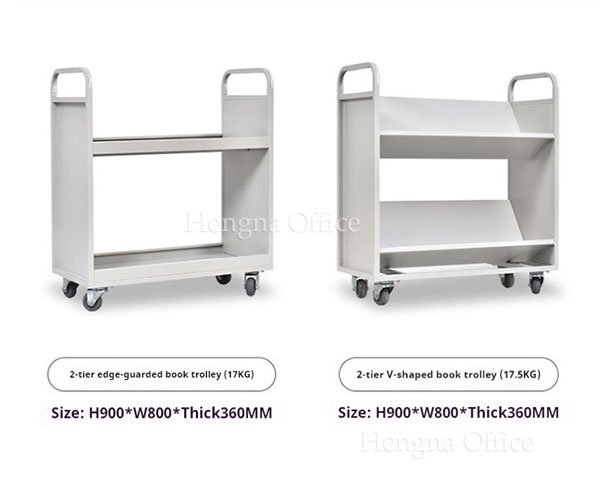
When you import Edge-Guarded Book Trolleys or V-Shaped Book Trucks from us:
- You Protect Your Brand: Your logo is on the product. If it rusts, your reputation rusts.
- You Reduce Returns: Automated manufacturing ensures that the 1,000th cart is exactly identical to the 1st cart. Consistency reduces inspection costs and returns.
- You Win Tenders: When bidding for government or university projects, being able to specify “Phosphated Anti-Rust Treatment” and “Robotic Welding” in the tender documents gives you a technical advantage over competitors offering generic specs.
Whether you need a classic 2-tier flat trolley for maximizing stack space or a V-shaped trolley for secure transport, the manufacturing process is just as important as the design.
At Hengna Office, we combine advanced automation with robust cold-rolled steel to produce library furniture that endures. Don’t let poor manufacturing compromise your product line.
Ready to upgrade your inventory? Contact our engineering team today to discuss your OEM/ODM requirements. We provide custom dimensions, colors, and structural designs to fit your market needs.