
Preserving Sample Integrity: Why Metal Pathology Cabinets Outperform Wood and Plastic in Humid Environments
In the very specific areas of pathology and histology, it is particularly vital to keep patient samples for a long time. For managers of laboratories and equipment procurement professionals, choosing the correct storage infrastructure isn’t just about having enough space; it’s also about keeping the environment under check.
One of the most significant things about the environment in a lab is the humidity. The amount of moisture in the air can alter based on where the building is or how it feels inside.
While wood and plastic storage solutions have their applications in general office settings, Cold-Rolled Steel Pathology Cabinets have become the industry preference for medical specimen storage. This article analyzes the material science behind this shift and explains why metal offers distinct advantages for preserving sample integrity in humid conditions.
The Impact of Environment on Specimen Storage
Before evaluating furniture materials, it is essential to understand the sensitivity of the items being stored. Pathology labs primarily store two types of physical records:
- Glass Slides: Fragile and heavy when accumulated.
- Paraffin Blocks (Tissue Blocks): Sensitive to temperature and moisture.
High humidity introduces several risks to these specimens:
- Adhesion: Moisture can cause glass slides to stick together, complicating retrieval.
- Biological Risks: Organic materials can become breeding grounds for mold if moisture is not controlled.
- Structural Stress: The storage unit itself must maintain its structural integrity despite environmental changes to ensure drawers function smoothly.
1. Material Stability: The Non-Porous Advantage
The primary difference between storage materials lies in how they interact with the surrounding air.
The Nature of Wood and Composites
Wood and certain laminate composites are natural or semi-natural materials. They possess hygroscopic properties, meaning they seek to reach an equilibrium moisture content with the surrounding air.
- In Humid Conditions: Wood fibers may absorb moisture, which can lead to subtle expansion. In a high-density storage unit where tolerances are tight, even minor swelling can affect how drawers slide or fit.
- Sterility: Wood surfaces are generally porous. While they can be sealed, maintaining a clinical-grade, non-porous surface requires constant maintenance to prevent the accumulation of particulates.
The Stability of Plastics
Plastic cabinets (often made of ABS or Polypropylene) are immune to moisture absorption, which is a significant benefit. However, plastics have a different relationship with the environment:
- Thermal Sensitivity: Plastics can react to temperature fluctuations often associated with humid environments, potentially leading to material softening or brittleness over extended periods.
The Metal Solution: Cold-Rolled Steel
Cold-Rolled Steel, the material used in our premium pathology cabinets, offers a decisive advantage: it is inert and non-porous.
- Impermeability: Steel does not absorb moisture. The structure remains dimensionally stable regardless of the humidity level in the room (Relative Humidity % ranges).
- Protective Coating: Our cabinets utilize an advanced Electrostatic Powder Coating. This process encapsulates the steel in a chemical-resistant shell. This not only prevents rust but also creates a surface that is easy to wipe down and sanitize, effectively eliminating the risk of mold growth on the cabinet surfaces.
2. Load-Bearing Consistency in Changing Climates
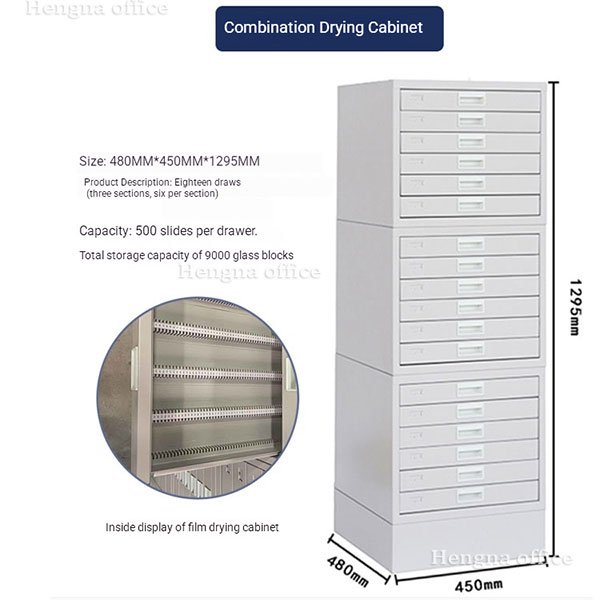
Pathology storage is unique because of the weight density. As noted in standard specifications, a single drawer may hold up to 500 slides. A full stack can weigh hundreds of kilograms.
The Challenge of Weight and Moisture
When a storage material is subjected to both heavy loads and environmental stress (like humidity), “creep” or deformation can occur.
- Plastic: While lightweight, plastics may experience gradual deformation (sagging) under constant heavy loads, especially if the ambient temperature rises. This can cause drawers to misalign.
- Wood: If wood expands due to moisture, the friction on the drawer runners increases. Combined with a heavy load, this can make drawers difficult to open, posing an ergonomic risk to lab staff.
The Engineering of Metal Cabinets
Our metal cabinets are engineered to handle these specific stresses without alteration.
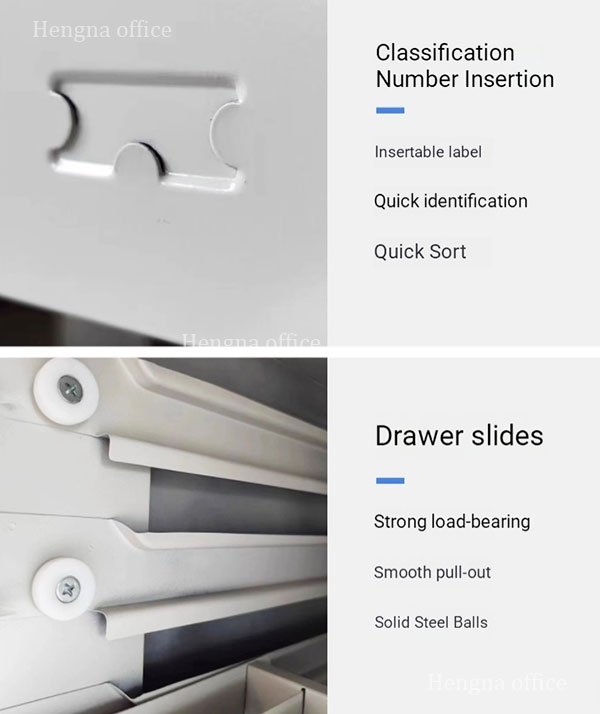
- Solid Steel Ball Slides: Referring to the product details, we utilize heavy-duty rails with solid steel balls. Metal-on-metal slide mechanisms (with proper lubrication) are unaffected by humidity. They ensure that a drawer loaded with 500 slides glides as smoothly in a humid tropical lab as it does in a dry climate.
- Rigid Frame: The cold-rolled steel frame maintains its squareness and rigidity, ensuring that the heavy weight of the glass blocks (9000 blocks per unit capacity) does not compromise the unit’s stackability.
3. Active Climate Control Features
For laboratories in regions with consistently high humidity, passive protection may not be enough. This is where the material properties of metal enable advanced functionality: The Drying Cabinet.
As shown in our “Combination Drying Cabinet” models, these units are equipped with PTC heating modules to actively control the internal environment.
- Thermal Conductivity: Metal is an excellent conductor. It allows for the even distribution of gentle heat throughout the cabinet, ensuring no “cold spots” where condensation could form.
- Safety: Integrating heating elements into wood or plastic cabinets presents complex safety challenges regarding fire resistance and material warping. Steel provides a non-combustible, safe enclosure for these electrical drying systems, allowing labs to actively dehumidify their samples.
4. Operational Efficiency: Labeling and Organization
Efficiency in a pathology lab is defined by retrieval speed. The design of the cabinet front plays a subtle but vital role here.
- Adhesive vs. Mechanical Labeling: In humid environments, adhesives on sticky labels can degrade, causing them to peel or slide.
- The Metal Solution: Our cabinets feature stamped metal label slots (Classification Number Insertion). This mechanical solution allows paper or card labels to be inserted securely. The metal frame holds the label in place physically, independent of adhesive quality. This small detail ensures that even after years in a humid storage room, the identification system remains intact.
Summary Comparison: Material Performance in Lab Storage
The following table outlines the behavioral characteristics of common cabinet materials in the context of a medical laboratory environment.
| Feature | Cold-Rolled Steel | Wood / Laminate | Industrial Plastic |
| Response to Moisture | Inert / Non-reactive | Hygroscopic (May absorb/release) | Inert / Non-reactive |
| Dimensional Stability | High (Maintains shape) | Variable (Subject to expansion) | Moderate (Subject to thermal creep) |
| Load Capacity (High Density) | Excellent (Ideal for glass slides) | Good (Dependent on construction) | Fair (Better for lighter items) |
| Sanitization | Easy (Chemical resistant coating) | Requires care to preserve finish | Easy (Chemical resistant) |
| Drying/Heating Integration | Safe & Efficient | Not recommended | Requires specialized materials |
| Durability (Long-term) | High (Resistant to wear) | Moderate | Moderate to High |
5. Modularity and Future-Proofing
Finally, the manufacturing precision of cold-rolled steel allows for superior modularity.
Standard units (Dimensions: 480mm * 450mm * 1295mm) are designed to be stackable. The high compressive strength of steel ensures that when units are stacked (e.g., three sections high), the bottom unit does not suffer from structural fatigue. This allows laboratories to maximize vertical space safely—a crucial factor for growing facilities.
Every material has its place in the world of furniture. However, when the mandate is to store heavy, sensitive medical specimens in an environment where humidity cannot always be perfectly controlled, Metal Pathology Cabinets offer the most robust and reliable solution.
By resisting moisture absorption, maintaining structural rigidity under heavy loads, and supporting active drying technologies, steel cabinets ensure that patient samples remain safe, organized, and accessible for years to come.
Partner with a Specialist Manufacturer
Are you looking for furniture for a medical facility or to add to your B2B catalog? We make experienced laboratory storage solutions as ODM and OEM.
We use high-quality cold-rolled steel and precision engineering to make our goods strong enough to fulfill the needs of pathology departments all over the world.