
How to Choose a Reliable OEM Manufacturer for Histology & Microscope Slide Cabinets: A Sourcing Guide
In the fast-paced world of medical research and diagnostics, the organization of a pathology lab is often what makes it work well. For companies that sell laboratory equipment and medical furniture, getting high-quality Histology & Microscope Slide Cabinets isn’t just about buying a metal box; it’s about making sure that important patient samples are safe for a long time.
When demand goes up, labs need storage systems that are strong, have a lot of space, and are easy to organize. If you’re a procurement manager or distributor, it’s very important for your reputation to find the right OEM manufacturer.
This guide will walk you through the essential criteria for selecting a manufacturing partner for lab storage solutions, ensuring you deliver the best value to your clients in the European and American markets.
1. Material Integrity: Why Cold-Rolled Steel Matters
The first question to ask any potential supplier is: “What material are you using?”
Pathology slides and paraffin blocks are surprisingly heavy when stored in bulk. A fully loaded cabinet containing thousands of glass slides puts immense stress on the structure.
- The Standard: Low-end manufacturers often use standard sheet metal (0.6mm or thinner) which can warp or buckle under heavy loads over time.
- The OEM Requirement: A reliable manufacturer must use High-Quality Cold-Rolled Steel Sheets (0.8mm – 1.0mm thickness).
Why Cold-Rolled Steel? Cold-rolled steel offers superior surface finish and tighter tolerances compared to hot-rolled steel. It allows for:
- Enhanced Durability: It resists denting and structural fatigue.
- Better Paint Adhesion: It ensures the electrostatic powder coating (crucial for chemical resistance in labs) adheres perfectly, preventing rust.
Pro Tip for Sourcing: Ask your factory if they apply an anti-rust treatment (pickling and phosphating) before powder coating. This is essential for the humid environments often found in “Combination Drying Cabinets.”
2. The Drawer Slide Mechanism: The Heart of the Cabinet
Referencing the engineering standards of top-tier cabinets, the drawer slide mechanism is the most common point of failure in inferior products.
In a Pathology Slide Cabinet, a single drawer might hold up to 500 slides. If the runners are weak, the drawer will stick, derail, or collapse.
Look for “Solid Steel Ball” Suspension
When evaluating an OEM sample, inspect the slide rails closely. You should look for:
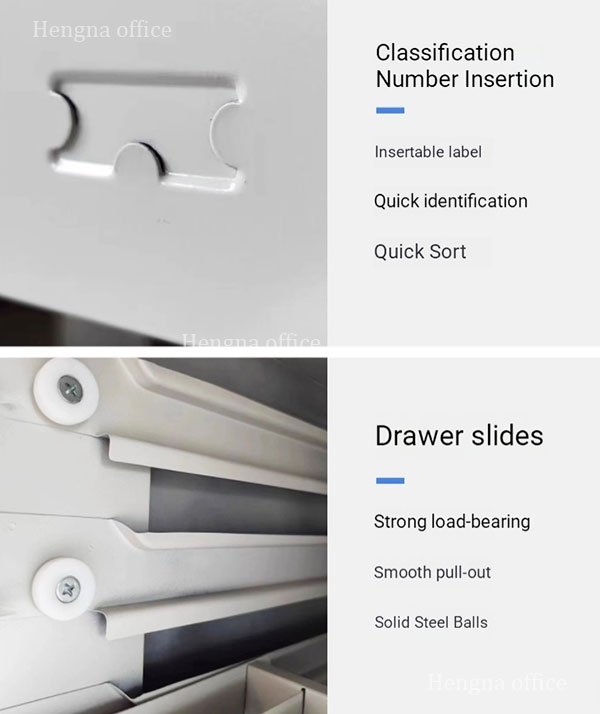
- Solid Steel Ball Bearings: As seen in high-end models, these ensure the drawer glides smoothly even when fully loaded.
- 3-Section Full Extension: This allows the user to pull the drawer out completely to access the slides at the very back without the drawer falling out.
- Quiet Operation: In a busy lab environment, noise reduction is a sign of quality engineering.
Checklist for Buyers:
- [ ] Does the drawer have a safety stop to prevent accidental removal?
- [ ] Is the slide rated for the weight of 500 glass slides?
- [ ] Is the movement smooth (no friction or grinding sounds)?
3. Storage Capacity and Modular Design
Space is premium real estate in any laboratory. Your B2B clients are looking for “High Density” storage solutions.
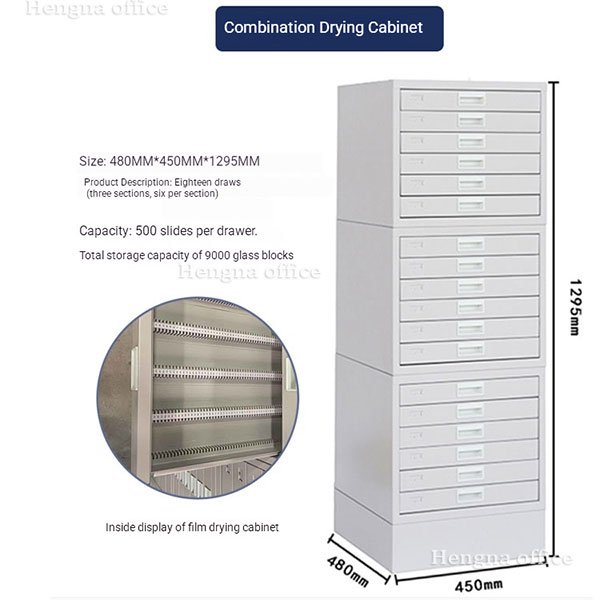
A competitive OEM manufacturer should offer modular systems. For instance, a standard vertical unit often combines multiple sections. A popular specification in the market (as shown in standard technical drawings) includes:
- Dimensions: Approx. 480mm (W) x 450mm (D) x 1295mm (H).
- Structure: 3 Sections stackable design (e.g., 6 drawers per section, totaling 18 drawers).
- Total Capacity: Up to 9,000 glass blocks/slides per unit.
The Power of Modularity
Why is a stackable design crucial for your inventory?
- Shipping Efficiency: Stackable units (Knocked Down or Split styles) save massive amounts of ocean freight volume.
- Client Flexibility: Labs can buy one section now and add more on top as their specimen count grows.
4. User Experience Details: Labeling and Retrieval
For the end-user (the pathologist or lab technician), the value lies in retrieval speed. How fast can they find Specimen #A-1234?
Reliable manufacturers pay attention to the “Classification Number Insertion” details.
- Integrated Label Slots: Stamped metal slots are superior to adhesive stickers which peel off over time.
- Visual Clarity: The label area should be large enough for standard barcodes or handwritten tags.
If your OEM factory ignores these small details, your product will be perceived as “cheap” by professional labs.
5. Comparison: Budget Supplier vs. Professional OEM
To help you make a quick decision, here is a comparison table highlighting the differences between a generic metal shop and a specialized Lab Furniture OEM.
| Feature | Generic Metal Factory | Professional Lab OEM (Recommended) |
| Material | Standard thin steel (0.5-0.6mm) | Cold-Rolled Steel (0.8mm+) |
| Coating | Standard spray paint | Electrostatic Powder Coating (Chemical Resistant) |
| Drawer Slides | Plastic rollers or friction slides | Heavy-duty Steel Ball Bearing Slides |
| Capacity | Unverified / Risk of sagging | Tested for 500+ slides per drawer |
| Labeling | Stick-on labels | Stamped/Integrated Slot Design |
| Customization | Limited to size | Full ODM (Color, Handle style, Logo, Interior slots) |
6. Customization Capabilities (ODM Services)
Finally, the biggest advantage of working with a direct factory is the ability to create a private label product.
A capable manufacturer should offer:
- Color Customization: Matching the cabinet color to the hospital’s interior (e.g., Pantone Medical White or Grey).
- Handle Design: Offering different handle styles (embedded vs. aluminum alloy handles).
- Interior Slotting: Customizing the internal metal dividers to fit specific brands of plastic cassettes or slide trays used in your target market.
Ask for a Prototype
Before committing to a 40HQ container, always request a prototype. Test the drawer load, check the paint finish, and verify the stackability.
Making a Deal, Not Just a Deal
It’s very important to pick the right OEM Manufacturer for Histology Cabinets. You need a partner that knows the difference between a filing cabinet and a system for storing medical devices.
Using cold-rolled steel construction, heavy-duty ball bearing slides, and smart modular designs can help you make sure that your brand stands for quality and dependability in the medical field.
Are you ready to improve the lab furniture you sell? As both ODMs and OEMs, we are experts at creating high-quality pathology drying and storage cabinets. We help huge companies get their products to labs all around the world by making sure they are of high quality and have robust production.